If you've spent any time with the Brovi pigment ecosystem, you know the lineup has expanded well beyond a single product line. Today there are three distinct collections — Brovi, Brovi+, and Brovi ONE — and the differences between them go deeper than just shade names. Each line was built around a different formula philosophy, a different technique profile, and a different client type. Choosing wrong doesn't just affect your results; it affects your workflow, your mixing decisions, and how your clients' brows look six months later.
This article breaks down exactly what separates the three lines, when to reach for each one, and how to combine them when a single line isn't enough.

The Baseline: Understanding What All Three Lines Share
Before getting into differences, it helps to understand the common foundation. All three Brovi lines are hybrid pigments — meaning they contain both organic and inorganic components. This is not a compromise; it's by design. Organic components provide rich, warm color payoff. Inorganic components, primarily iron oxides, add stability and predictability to the healed result. The combination gives you the visual warmth of an organic pigment with the longevity and color consistency you'd expect from an inorganic one.
All three lines are also manufactured under quality certifications from both Russia and the European Union, use safe, dermatologically tested ingredients, and are designed to fade naturally over time — lightening to a soft, natural shade rather than shifting to an unwanted color when the client comes back for a touch-up.
That said, the formulas diverge significantly in base composition, viscosity, particle size, and behavior in the skin — and those differences determine everything about how and when you use each line.
Brovi (Original Line): The Workhorse
What it is
The original Brovi brow line uses a hydroalcoholic base — aqua, Hamamelis virginiana extract (witch hazel), glycerin, and alcohol. The glycerin content is important: it gives the pigment a slightly thicker consistency that helps thin hair stroke lines hold their shape during implantation. The witch hazel extract acts as a natural antiseptic and skin toner, which contributes to a cleaner healing process.
Compared to Brovi+ and ONE, the original line has larger color particles and a more saturated formula. This means it implants more densely, heals with more visible color retention, and requires more deliberate technique to achieve light, airy results.
Who it's for
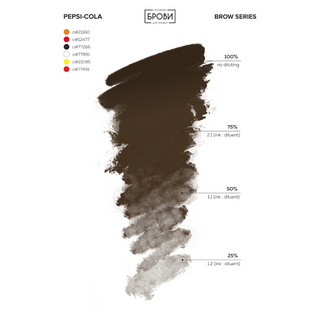
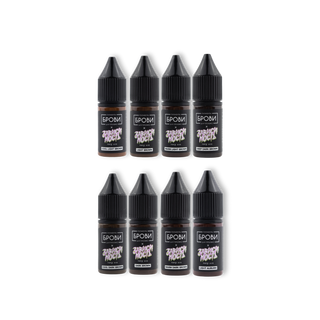
The original Brovi line is the most versatile in terms of client range. It spans a full spectrum from light blondes (Flat White, Cinnamon Sticks) through medium warm browns (Roasted Chestnut) to dark and neutral shades (Bitter Chocolate, Gray Harbor, Pepsi Cola). There's also a corrector set — Orange, Yellow, Green, Red-Orange — that covers every correction scenario from gray PMU to cold-toned lips.
It's the line you reach for when you need density, saturation, or predictable coverage. Clients with normal to dry skin, good skin texture, and average Fitzpatrick I–IV are well-served by the original line.
Techniques
The original Brovi line works for both hair strokes and powder brows, but its strength is in the powder and combination technique. Because the formula is more viscous and the particles are larger, it fills the skin more completely — which is exactly what you want for powder brows. For hair strokes, it performs best when diluted with Brovi Dilutor to control the saturation and prevent lines from bleeding.
Key rule: Never dilute with water. Brovi Dilutor is specifically formulated to reduce concentration without disrupting the formula. Water changes the chemistry and compromises both implantation and the healed result.
The corrector system
One of the biggest advantages of the original Brovi line is its corrector set:
Orange neutralizes cool gray and blue shades from old or poorly executed PMU. It also adds warmth when working on very cool-toned skin. If your client has previously healed brows that have gone steel-gray or blue-gray, orange corrector is your first step.
Yellow neutralizes lilac shades and lightens the main pigment for very fair skin or white hair. Use it over light purple corrections or when you need a softer, more delicate result on clients with very pale complexions.
Green goes over light red or orange brows that haven't faded evenly. It's a counterpart to orange — same logic, opposite direction on the color wheel.
Red-Orange is specifically for lip work — cold-toned lips on Asian or African phototype clients, or lips that turn blue in cold weather. It's implanted as a first layer, dense and without mixing, before the main lip color is applied in the same session.
These correctors work with the original Brovi line and should not be added to Brovi+ pigments, which already have a warm formula and don't benefit from additional warmth.
Brovi+ (The Hairstroke Specialist)
What it is
Brovi+ was formulated specifically to address the demands of the hair stroke technique. The base is completely different from the original line: deionized water and Hamamelis virginiana extract only — no alcohol, no glycerin. This gives Brovi+ a significantly more liquid consistency, and the color particles are much finer than in the original line.
The New Formula version, which is what's currently available, also removes titanium dioxide from the formula and reduces the black pigment load using CarbonCut technology. Less black pigment means less risk of the healed result pulling cold or dark, and easier natural fading over time.
Who it's for
Brovi+ is designed for clients where the technique demands precision, lightness, and a natural healed appearance. Because the particles are smaller and the formula is more liquid, pigment flows more easily through the needle, creates finer lines, and the individual strokes remain more defined after healing. The risk of unwanted color shifts is minimized — the New Formula shades are designed to heal into the color they look like going in.
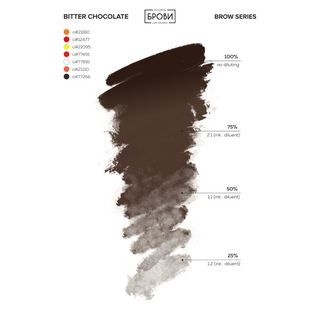
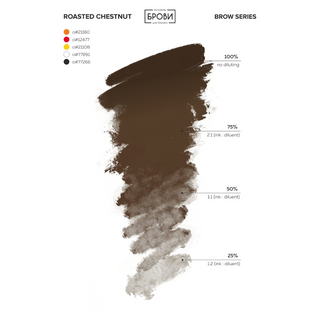
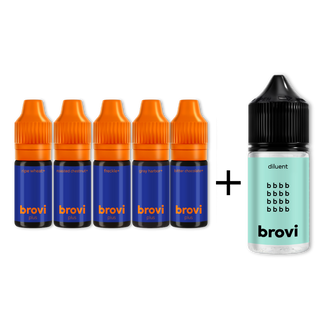
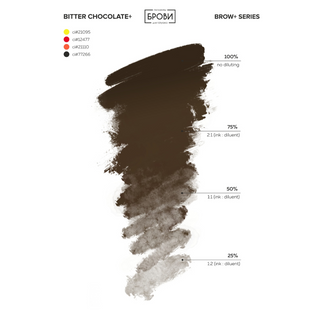
The Brovi+ range covers the core brow spectrum: Roasted Chestnut (universal warm brown), Ripe Wheat (light warm brown for Fitzpatrick I–III), Bitter Chocolate (dark warm brown for Fitzpatrick IV–V), Gray Harbor (neutral blonde for cool-toned and ash clients, Fitzpatrick II), and Freckle (warm orange-brown, no mixing required).
Techniques
This is where Brovi+ distinguishes itself most clearly. The line was built for hair strokes and for airy, natural-looking powder brows. The liquid consistency means it flows into fine needle penetrations without resistance, creating crisp lines that stay defined through healing. It can also be implanted more densely when needed — the fine particles won't crowd the skin the way a thicker pigment would.
Because Brovi+ is already warm, correctors should not be added to it. The formula is designed to be used as-is. Roasted Chestnut+ and Freckle+ are particularly noted as not needing any mixing at all — open, load, work.
For Brovi+ pigments that are too light for a particular client, the correct adjustment is to mix in a corresponding shade from the original Brovi line in a ratio that suits the desired saturation — for example, 7 drops of regular Roasted Chestnut to 3 drops of Roasted Chestnut+. This gives you more density without compromising the Brovi+ formula's behavior. Do not mix Brovi+ shades with correctors.
One important note for mixing within the Brovi+ line: Roasted Chestnut+ and Bitter Chocolate+ should not be mixed together, because both have a warm orange base — you'd end up with an oversaturated warm result without the tonal contrast you need. For a neutral result, mix Gray Harbor+ with Bitter Chocolate+.
The Dilutor rule
Because Brovi+ is already liquid, the Dilutor serves a narrower purpose here: saturation control only. You're not thinning the formula for flow — it already flows well. You're using Dilutor to reduce color concentration for clients with very fair skin, or when you want an exceptionally soft, muted healed result. A few drops is enough. The same rule applies: Brovi Dilutor only, never water.


Save $54.85
Save $24.53
Save $24.53


Save $56.44

Brovi ONE (The Inorganic Line)
What it is
Brovi ONE is a fundamentally different product from the original Brovi and Brovi+ lines. While both of those are hybrid pigments — organic and inorganic components combined — Brovi ONE is a pure inorganic pigment line. No organic colorants. The color is derived entirely from mineral-based pigments, which behave very differently in the skin than organic components do.
This isn't a variation on the Brovi formula; it's a separate technical approach to brow pigmentation.
Who it's for
Brovi ONE is for clients and artists where inorganic chemistry is the priority. The key characteristics of inorganic pigments are well-established in the PMU world: they are highly stable, they do not oxidize, and they fade slowly and predictably without shifting to unexpected colors. They are also generally considered safer for clients with known sensitivities to certain organic colorants.
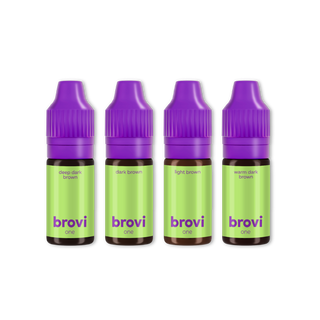
The Brovi ONE line includes both warm and cool shades — Warm Dark Brown, Dark Brown, Deep Dark Brown, Cool Dark Brown, Light Brown, Cool Light Brown, and Ultra Black. The range covers everything from very light natural brows to intense dark results, with both warm and cool options at multiple depths.
Techniques
Inorganic pigments have specific handling characteristics that differ from hybrid lines. They tend to be thicker and require a different application approach — the artist needs to work with the pigment's natural viscosity rather than against it. Implanted correctly and superficially, inorganic pigments give excellent results in both powder brows and hair strokes, though they are particularly well-suited to pixel technique and mineral powder brows where the precise, defined quality of inorganic color works in your favor.
Because there is no organic component, Brovi ONE shades do not have the warmth that the original and Brovi+ lines naturally carry. This makes them excellent for clients who want a cooler, more neutral result — think ash-toned brows on fair Nordic skin types, or natural-looking brows on clients with cool undertones who would look unnatural with a warm pigment.
When NOT to use Brovi ONE
The inorganic formula also means that corrections work differently. You cannot mix Brovi ONE with the original Brovi or Brovi+ shades as you would mix within a line — the organic and inorganic components have different chemical properties and don't interact predictably. If you need to adjust the tone of a Brovi ONE shade, the adjustment should be made using other Brovi ONE shades or appropriate inorganic correctors, not by pulling from the hybrid lines.
Laser removal also behaves differently with inorganic pigments — they typically require more sessions and can sometimes oxidize during laser treatment, which is a normal but important consideration to discuss with clients before the procedure.
Practical Decision Guide
Use Brovi (original) when:
- You're doing powder or combination brows and need density
- Your client has old PMU that needs color correction
- You need to mix a custom shade from a wide palette
- Your client has normal to dry skin and average texture
- You're correcting gray, blue, lilac, or red brows with correctors
Use Brovi+ when:
- Hair strokes are the primary technique
- You want a light, airy, natural-looking result
- Your client has sensitive skin or you want minimal trauma
- You need the crispest possible line definition through healing
- Your client's Fitzpatrick type demands a warm, predictable healed color
Use Brovi ONE when:
- Your client has known sensitivities to organic colorants
- You want a cool or neutral result without warmth
- You're working with pixel technique or mineral powder style
- Your client explicitly wants a natural, understated result without warm undertones
- You have a client with very fair, Nordic or ash-toned coloring where Brovi+ would read too warm
When to Combine Lines
The lines are not mutually exclusive. Experienced artists often use them in combination:
Brovi + Brovi+ is the most common pairing. When Brovi+ is too light for a client, adding original Brovi in a 70/30 or 80/20 ratio gives you more density while keeping the flow and fine-particle behavior of the + formula. This is particularly useful when doing hair strokes on medium-to-dark clients where Brovi+ alone doesn't provide enough color payoff.
Brovi correctors + Brovi+ should be avoided. Because Brovi+ already carries a warm base, adding orange or yellow corrector pushes it into an oversaturated warm result that can heal unnaturally orange. If you need to neutralize old PMU before working with Brovi+, apply the correction layer with original Brovi corrector and allow it to process separately before adding the Brovi+ hair strokes over the corrected base.
Brovi ONE + either hybrid line should not be mixed in the same pigment load. If you're using Brovi ONE for the primary brow color and want to add warmth, use a Brovi ONE warm shade rather than trying to blend in Brovi or Brovi+.

The Bottom Line
Brovi, Brovi+, and Brovi ONE are three genuinely different tools — not just variations of the same formula. The original line gives you density, a broad palette, and a corrector system for complex cases. Brovi+ gives you precision, liquidity, and the cleanest possible hair stroke result with predictable warm healing. Brovi ONE gives you the chemical stability and cool neutrality of pure inorganic pigments for the clients and styles where hybrid formulas aren't the right answer.
Understanding which line you're reaching for — and why — is what separates a technically confident artist from one who is guessing. Most well-stocked PMU kits include at least Brovi+ for hair strokes, one or two original Brovi shades for powder work and corrections, and Brovi ONE for specific client profiles. From there, the palette is yours to build around the clients you see most.